Environmental Management
Climate change | Waste | Responsible sourcing | Environmental Disposal & Product Risk | Partnerships
Environmental ManagementThe Ergonomic Solutions Group takes its environmental responsibilities seriously.
We recognise that our activities have an impact on the environment in terms of the use of raw materials, emissions into the air, water, and waste generation. The company seeks to minimise this as far as is reasonably practicable.
As part of our commitment to sustainability, we have achieved group-wide ISO 14001:2015 certification, which demonstrates our dedication to environmental management.
The Ergonomic Solutions Group is committed to:
Continual improvement in our environmental performance
Preventing pollution
Compliance with all environmental legislation, regulations and codes of practice relevant to our industry
Climate Change
At Ergonomic Solutions, we calculate our carbon footprint each year based on our energy consumption: fuel, electricity and gas for the period 1 January – 31 December.
Trends for Ergonomic Solutions Manufacturing: CO2 Emissions
In 2024, Ergonomic Solutions Manufacturing A/S reduced our scope 1 and 3 emissions compared to our previous years data.
Scope 1 (direct emissions) reduced by 14% based upon the continued switch to bio-gas (previously introduced in 2023) and changing working patterns. In 2025, we have reduced this even further with strategic changes to the temperature used in our manufacturing processes.
Scope 2 emissions which relate to the use of electricity and district heating usage, have remained stable even with a 1300M2 expansion to our factory during 2024. This is based on our continued commitment to partner with the right providers in order to become carbon neutral by 2030.
Ergonomic Solutions Manufacturing A/S is proud to be ahead of target for our '2025 Science Based Target of a 15% reduction in scope 3 emissions by products shipped from 2018 figures', achieving the target early in 2024. This equates to 7.6 kilos and is mainly based on our documented use of scrap steel.
Waste
Ergonomic Solutions’ Northern Region participates in a waste reduction scheme
Waste segregation:
Recycling of all card and paper
Recycling of other mixed recyclables
Recycling of disposable batteries
Recycling of used printer cartridges
Segregation at source helps us to achieve our target of reducing general waste. Our general waste is currently one-third of what was generated before segregation for recycling.
Awareness of plastic usage is an explicit cornerstone of our Environmental Policy and by the end of 2019, we discontinued the use of plastic cups in our factory in Denmark.
In 2019 the Ergonomic Solutions Group implemented double-sided printing as standard in all locations to prevent unnecessary paper usage, and we implemented a new automated paint shop, where we now are recycling 100% of paint powder and thereby eliminating any waste. We have also implemented low-temperature paint powder in Q2 2025, which reduces LPG usage by 17% yearly.
Other Waste Reduction Initiatives:
Implemented re-use of rainwater for toilets in new extension
This, and other initiatives, has made it possible to reduce water usage in the factory by 5% in 2024, compared to 2023
Solar panels installed on our new factory extension
Supplying 50,000kWh on a yearly basis.
All internal vehicles in the group are electrical as of start 2024
(e.g. no gas forklift trucks)
All company cars are EV as of Q2 2025
The Ergonomic Solutions Green Initiative
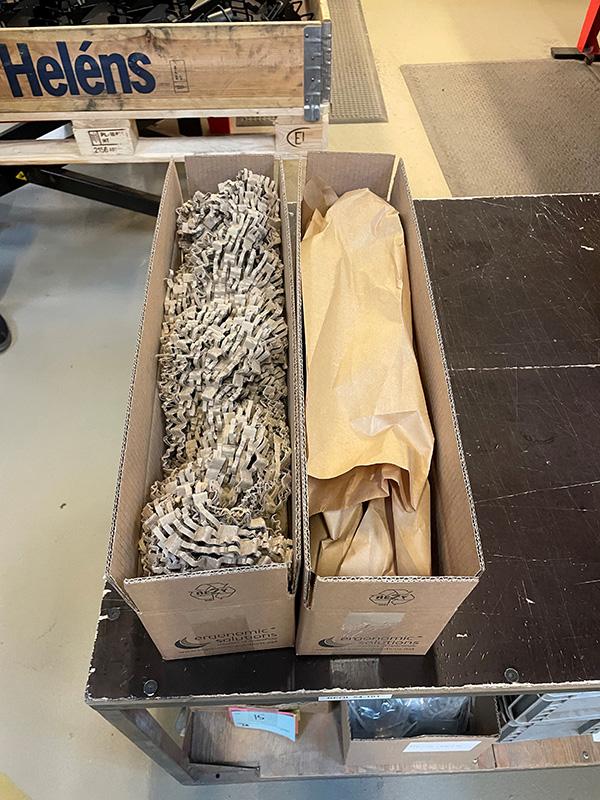
Recycling our incoming cardboard boxes as packaging material
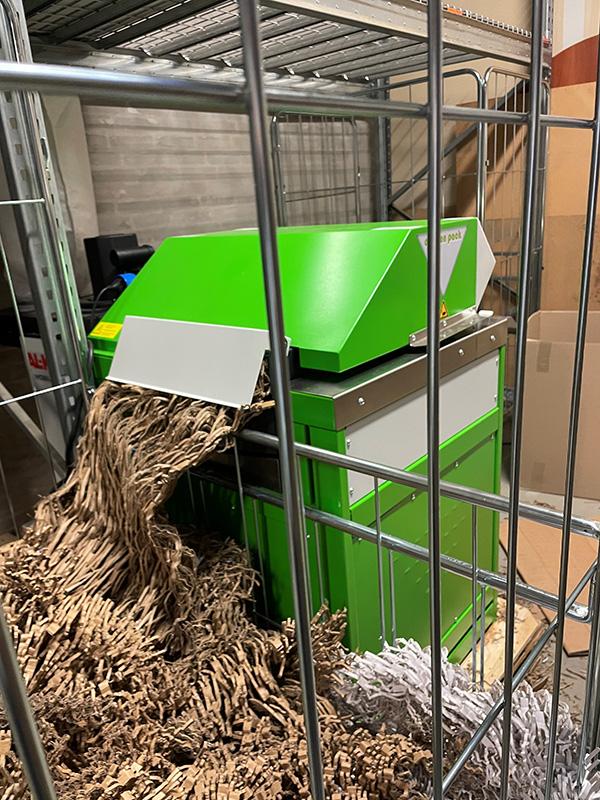
In November 2021, we introduced a shredder machine that allows us to reuse incoming cardboard as packing material within our packing process.
This brings a number of important improvements to our incoming and outgoing packing processes, all of which have a positive impact on our local environment.
We will no longer have to purchase 5.5 tons of cardboard per year for use as packing material
By recycling our incoming boxes, we utilise what was previously waste cardboard
This a more environmentally friendly method of packing which has an improved impact on our carbon footprint
The shredding process has been comprehensively tested for dust ingress, and all were positive with no impact on our products.
Responsible Sourcing
We will continue to ensure responsible sourcing in the selection of materials and reduce the impact of resources used to operate the buildings.
Our aim is to:
Work towards an incident-free and zero harm environment
Create a great place to work where all staff are valued, respected and motivated and are knowledgeable about environmental issues and impacts
Encourage local sourcing across the business
Create a positive impact on the communities where we work
Environmental Disposal & Product Risk
Partnerships
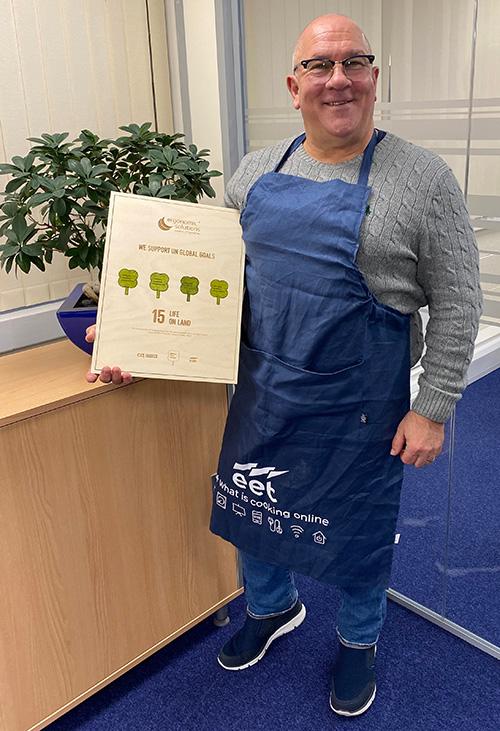
Ergonomic Solutions are proud to support EET Group A/S’ “Green Friday” initiative
Since 2021, Ergonomic Solutions / SpacePole Inc has contributed 48,000 trees to the EET forest. EET, a distribution partner of Ergonomic Solutions, partnered with Ecologi, a company focused on addressing climate crises.
To transform "Black Friday" into "Green Friday," EET invited select partners to support this initiative by contributing trees to their forest.
So far, our trees have supported projects in:
- Reforestation in Changalane and Mussuquelane in Mozambique
- Mangrove planting in Marotaola and Kadrany in Madagascar
- Forest restoration in Kenya
With species including:
- Adansonia digitata
- Rhizophora mucronata
- Dodonaea viscosa
- Acacia nilotica
- Bruguiera gymnoohiza
Ergonomic Solutions CEO and Group Managing Director says:
“Sustainability and the environment are at the forefront of our business. It’s exciting for us to be supporting our partner EET in this way”.
The reforestation projects support the UN Sustainable Development Goals, number 15 for Life on Land, which covers sustainable management of forests and combating desertification.